Cracks and Holes Corrected Before the Paint Goes On
Drywall repair and painting in Decatur for walls and ceilings where damage requires professional correction rather than surface coverage
Painting over a drywall crack does not stop it from reappearing—it makes it visible again within months, sometimes through two fresh coats. Rodriguez Roofing & Remodeling LLC repairs and repaints damaged drywall in Decatur and Northern Alabama, addressing the underlying condition before applying any finish so the repaired area blends with the surrounding wall and stays that way. The work covers cracks, holes, and water-damaged sections across residential and commercial interiors.
Damage severity determines the repair method. Small holes are patched with spackle and sanded smooth. Larger damage—fist-sized holes, damaged corners, or areas where the paper face is torn—requires mesh and joint compound applied in layers, with each layer allowed to dry fully before the next is added. If water damage or structural issues have compromised the drywall panel itself, the affected section is cut out and replaced rather than patched over. Every repair is sanded, primed, and painted with a finish coat that matches the surrounding wall in both texture and sheen, so the repaired area is not identifiable by sight or touch once complete.
Arrange an on-site damage review so the repair approach and painting scope can be assessed accurately before work begins.
How Proper Drywall Repair Holds Up Over Time
Settlement in older Northern Alabama homes generates cracks at predictable locations—corners, door headers, the junction between interior walls and ceilings—because those are the stress concentration points where the structure moves as it settles. Painting over those cracks fills them temporarily, but the underlying movement continues and the paint film separates along the same line. Correct repair involves opening the crack, applying joint compound in multiple thin passes rather than one thick layer, and feathering the edges far enough out that the repair is not detectable as a raised ridge under the finish. Rodriguez Roofing & Remodeling LLC uses that multi-pass approach on all structural cracks rather than filling and painting in a single session.
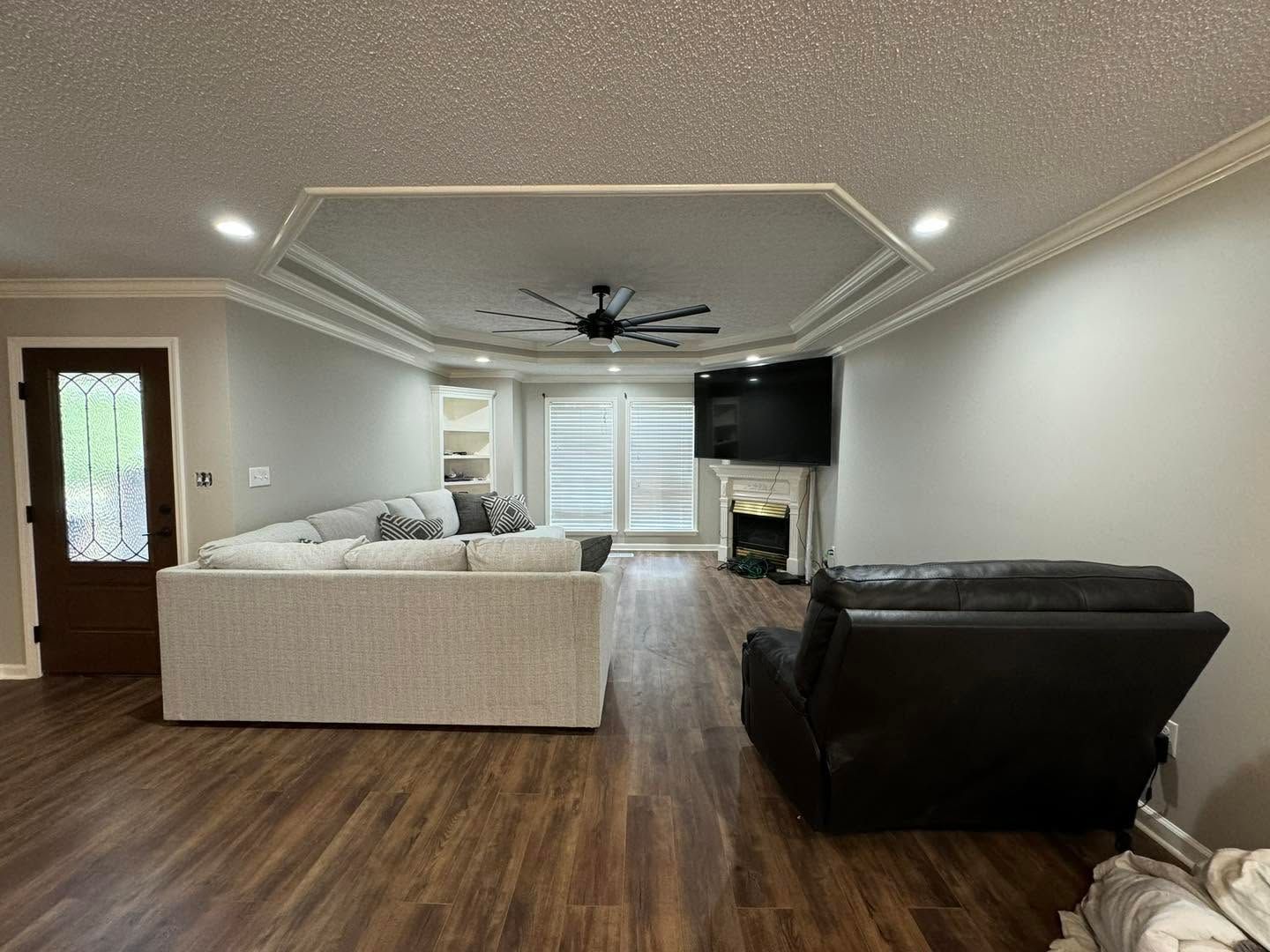
After repair and painting are complete, what you will notice is a wall surface that reads flat and consistent under light from any angle—no ridge lines, no texture mismatches at the repair boundary, and no sheen variation between the patched area and the surrounding paint. Those are the three failure indicators that identify a surface-only patch: the ridge where compound was applied too thick, the rough halo where texture was not matched, and the dull spot where primer was skipped over the repair.
Water-damaged drywall requires one additional step that surface patching does not: confirming the moisture source is no longer active before closing the wall. Patching and painting over active moisture produces a result that fails within weeks and may conceal ongoing damage to framing or insulation behind the wall. That determination is made during the assessment phase, and if the source of moisture needs to be addressed first, that is communicated clearly before any repair work proceeds.
Questions Before Starting Your Drywall Repair Project
Drywall repair involves more decision points than it appears to from the outside. The questions below address how repairs are sequenced, what distinguishes a surface patch from a structural fix, and what the finished work should look like.
How do you determine whether a crack requires patching or full section replacement?
A hairline crack at a corner or door header is typically a settlement crack that responds to joint compound—a crack with separation wider than a pencil, soft or crumbling edges, or visible staining alongside it may indicate the panel itself is compromised and requires section replacement rather than surface repair.
Why does joint compound need to be applied in multiple thin layers rather than one thick pass?
Thick compound shrinks as it dries and pulls away from the substrate at the edges—thin layers applied in sequence dry with less shrinkage, bond more consistently, and produce a surface that can be sanded flat without leaving a visible ridge at the repair boundary.
What should you do before a crew arrives to assess water-damaged drywall?
Identify whether the source of the moisture—a roof leak, plumbing drip, or condensation issue—has been addressed or is still active, because repair cannot proceed effectively over an ongoing moisture source, and knowing the source history helps the crew assess whether the damage is limited to the face of the wall or has reached the framing.
How does priming affect the appearance of a drywall repair after painting?
Unprimed joint compound is highly porous and absorbs paint differently than the surrounding drywall face—without primer, the repair shows as a dull spot under any sheen level, even flat paint. Primer applied specifically to the repair area before finish coat is what makes the patch blend rather than stand out.
What is the correct way to match existing wall texture on a repaired section?
Identifying the texture type—orange peel, knockdown, skip trowel, or flat—determines the application tool and technique needed to replicate the pattern. Testing the texture match on a scrap piece before applying it to the wall avoids the situation where the repair is mechanically sound but visually identifiable because the texture pattern does not match what surrounds it.
Rodriguez Roofing & Remodeling LLC also provides drywall repair and painting in Tanner, Flint City, Priceville, Hartselle, and Triana. Call 256-280-1510 to schedule a damage assessment and get a clear picture of what the repair and repainting scope involves for your space.